Keto Tuna Casserole
Classic tuna casserole made low carb with cauliflower florets in place of noodles, a creamy cheddar and cream cheese sauce, and a crisp parmesan top. 30 g protein and about 9 g net carbs per serving.

This post has affiliate links. As an Amazon Associate I earn from qualifying purchases. Disclosure
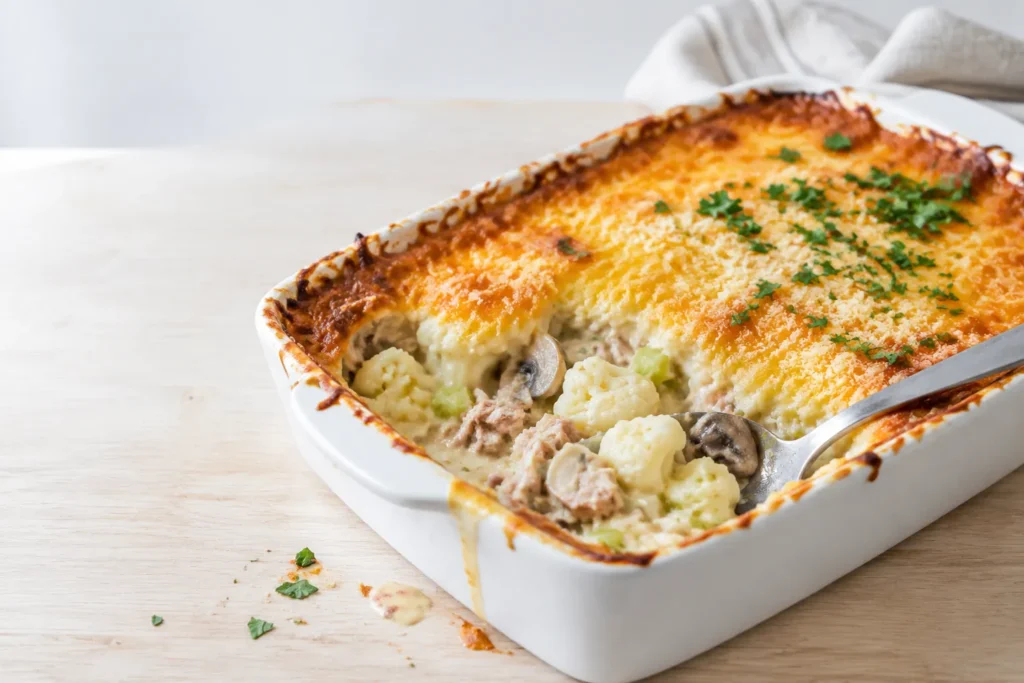
Some casseroles are fancy. This keto tuna casserole is not trying to be. It’s the old pantry dinner, the one with canned tuna and a creamy sauce and a cheesy top, just with tender cauliflower where the egg noodles used to be.
It bakes in one dish, it feeds six, and every serving has 30 grams of protein and about 9 grams of net carbs. You steam the cauliflower, make a quick sauce in one skillet, fold it all together and let the oven do the browning. It’s a weeknight dinner that tastes like it took longer than it did.
Where tuna casserole comes from
Tuna casserole is about as American as a weeknight dinner gets. Casseroles took off in American homes in the 1950s, mostly because the ingredients were cheap and easy to find at the supermarket. Campbell’s put out a cookbook built around its canned soups in 1952, and it had a tuna casserole in it. That’s the version a lot of people know: canned tuna, egg noodles, a can of cream of mushroom soup stirred in, sometimes a handful of peas.
The topping was always the fun part. Breadcrumbs, crushed potato chips, fried onions or corn flakes went on top so the spoon cracked through something crunchy before it hit the creamy middle. It was also the dish people carried to potlucks, especially in the Midwest, and the one people brought over when somebody was sick or grieving, so they didn’t have to cook. A casserole that travels well and feeds a crowd has been doing that job for a long time.
At our table
I cook every recipe on this site in my own kitchen first. My bar for a low carb casserole is simple: it has to eat like the real thing, the way my cheesesteak casserole does. A tuna casserole has to clear that same bar, and the cheesy top helps a lot.
This is the kind of dinner that fits the busy stretch of the year. December fills up fast with school concerts, shopping and cookie baking, and the oven is spoken for half the week. A casserole that comes together from the pantry and a head of cauliflower saves a night. Then January comes, the holiday food is gone, and a big pan of something warm and cheesy that reheats for lunch is exactly what I want. If you’re already planning the holiday morning, my Christmas breakfast casserole is another one you can put together ahead and slide into the oven.
How a low carb tuna casserole works
Two things carry the carbs in the classic version: the egg noodles and the canned cream soup, which is thickened with wheat flour. Both are gone here.
Cauliflower takes the place of the noodles. Cut into small florets and steamed until a knife just slides in, it holds its shape in the oven and soaks up the sauce the way pasta does. The one thing to watch is water. Cauliflower keeps a lot of it, and so does canned tuna. Drain both well, and let the florets steam dry in the colander for a few minutes before they go into the sauce. That’s the difference between a creamy casserole and a soupy one.
The sauce stands in for the can of soup, and it’s barely more work. Butter, a little onion, celery and a full 8 ounces of sliced mushrooms go into a skillet until the mushrooms brown and their liquid cooks off. Then chicken broth, cream cheese and heavy cream get whisked in and simmered for a few minutes. The cream cheese is what makes it thick without flour. A cup of sharp cheddar and a teaspoon of yellow mustard finish it off.
Four cans of tuna is more than most old recipes use, and it’s on purpose. It’s where most of the protein comes from. For the crunchy top, grated parmesan and a couple of spoonfuls of almond flour go over the last of the cheddar, and they bake into a golden crust you can hear when the spoon goes in.
The numbers come from USDA FoodData Central. Each serving has 446 calories, 30 grams of protein, 12 grams of total carbs, 3 grams of fiber and 32 grams of fat, so net carbs come to about 9 grams. Peas aren’t in this one, since they add carbs fast. If you stir some in, they aren’t counted in those numbers.
The tuna is already cooked in the can, so the oven is just heating everything through and browning the top. Still, use a thermometer and bake until the center reaches 165°F (74°C), the safe temperature for casseroles and leftovers. That usually takes 20 to 25 minutes at 400°F.
A few swaps that keep it low carb:
- Use canned salmon or albacore tuna in place of the chunk light tuna.
- Swap the cheddar for Monterey Jack, Swiss or Gouda.
- Use chopped broccoli florets for half of the cauliflower.
- Skip the almond flour and top with parmesan alone.
01Ingredients
02Gear & pantry
03Method
Tap a step when it's done. The next one lights up.
0 OF 9 DONE04Recipe notes
- 01Nutrition per serving (1/6 of the casserole): 446 calories, 30 g protein, 12 g total carbohydrates, 3 g fiber, about 9 g net carbs (total carbs minus fiber), 32 g fat. Calculated from USDA FoodData Central. Peas are not included; if you add them, the carbs go up. Drain the tuna and cauliflower well so the casserole isn't watery. Make ahead: assemble, cover and refrigerate up to 1 day, then bake from cold for 10 to 15 minutes longer. Refrigerate leftovers within 2 hours and use within 3 to 4 days. Freeze portions up to 2 to 3 months for best quality, thaw overnight in the fridge, and reheat to 165°F.
05Nutrition
Per serving- Calories
- 446
- Protein
- 30G
- Net carbs
- 9G
- Fat
- 32G
- Fiber
- 3G
Net carbs are total carbs minus fiber. Numbers are estimates from the ingredients listed.
How did it turn out?
No ratings yet. Tap a star to be the first.
Snap a photo and tag @recipe_smoke1 so I can see how yours came out.
Make ahead, storing and reheating
You can build the whole casserole up to a day ahead. Assemble it, cover it and keep it in the fridge, then bake it straight from cold and add 10 to 15 minutes. Leftovers go into the fridge within two hours of baking and keep 3 to 4 days, per the USDA’s guidance on leftovers. To freeze it, let it cool, cut it into portions, wrap them tightly and freeze for up to 2 to 3 months for the best texture. Thaw overnight in the fridge. The cauliflower turns a little softer after freezing, but the flavor holds. Reheat in the oven at 350°F, covered, or in the microwave, until it’s hot in the middle and reaches 165°F.
Questions about keto casserole recipes
Is this one of those keto casserole recipes for easy dinners?
It is. It uses pantry tuna, one skillet and one baking dish, and it’s on the table in about 45 minutes.
Can I use riced cauliflower?
You can, but florets hold up better and give it the bite of noodles. If you use riced cauliflower, squeeze it dry in a towel first.
Is tuna casserole keto without the noodles?
This one is. With the noodles and canned soup gone, it comes to about 9 grams of net carbs per serving, under the 10-gram line for a keto main.
Set it on the table with a green salad and a big spoon, and let everyone go for the corner pieces first. Those are the ones with the most crust.
 Casseroles
 Breakfast
 Casseroles

