Keto Salmon Bowl
Oven-baked salmon over garlicky cauliflower rice with avocado, cucumber and a cool lime-cilantro cream sauce.

This post has affiliate links. As an Amazon Associate I earn from qualifying purchases. Disclosure
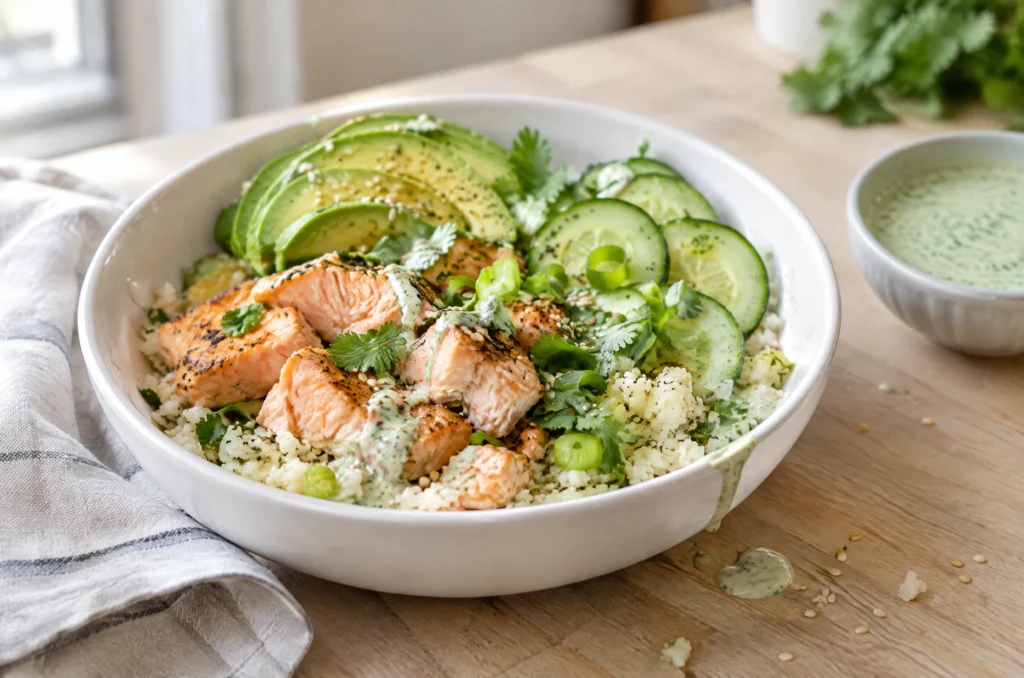
A keto salmon bowl is what I make when the week has been heavy and I want dinner to feel light without being a salad. Salmon baked until it flakes, warm cauliflower rice, cold cucumber, a creamy avocado half, and a green sauce poured over all of it. Twenty-five minutes, one sheet pan, one skillet.
I cook every recipe in my own kitchen before it goes on the site, and this bowl got tested more than once for one reason: the temperature contrast. Hot salmon and hot rice next to cold cucumber and cool sauce is the whole point. If everything is the same temperature, it’s just a plate of food. If it isn’t, every forkful is a little different.
Where the bowl idea comes from
Grain bowls are one of those meals that don’t belong to any one cuisine. Cooked grain or rice at the bottom, something savory on top, a few raw vegetables for crunch, a sauce to tie it together. Salmon fits that format well because it’s rich enough to carry the plate and it cooks fast. The usual version sits on white rice, which is the part I changed.
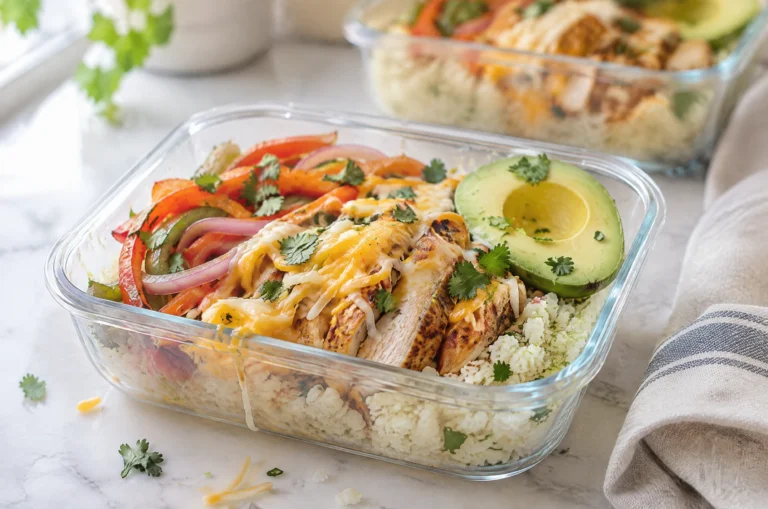
On this site we already have a Low Carb Chicken Fajita Meal Prep Bowls recipe for the bowls you pack on Sunday. This one is the opposite: assemble it fresh, eat it the same night, and don’t pack it for tomorrow.
What makes this keto salmon bowl different
I wanted a bowl that wasn’t spicy mayo and wasn’t hummus, since those are what most salmon bowls lean on. So the sauce here is plain whole-milk Greek yogurt and mayonnaise blended with lime juice, a big handful of cilantro and one garlic clove. It’s cool, green and tangy, and it takes about two minutes in a small blender or a jar you shake hard. A splash of water thins it to pourable.
The salmon is the simplest part. Six ounces per person, skin off, rubbed with olive oil, salt and pepper, into a 400°F oven for 12 to 15 minutes. Thinner fillets are done at 12. Thick ones need the full 15. You’re looking for flaky, opaque fish that reads 145°F (63°C) in the thickest part, the same number on the USDA’s safe minimum internal temperature chart. A cheap instant-read thermometer ends the guessing.
While it bakes, the cauliflower rice goes into a skillet with a spoonful of olive oil and a pinch of salt. Let it sit for a minute before you stir so it browns a little at the edges, then cook it about five minutes total. Don’t cover the pan. Steam is how you end up with wet, mushy cauliflower. A squeeze of lime at the end wakes it up.
At our table
Salmon is the dinner for nights when you want something that tastes like a treat but doesn’t leave you heavy afterward. It’s also one of the few foods where the health reason is easy to state plainly: the NIH Office of Dietary Supplements lists salmon among the cold-water fatty fish that are food sources of omega-3 fatty acids. I don’t need more reason than that to put it on the table once a week.
If your week is mostly soups and stews, which is how mine goes once it turns cold, this bowl is the break between them. When you’re back to a big pot, my keto soup roundup for winter nights has seven to rotate through.
How it stays low carb and high protein
Swap the rice for cauliflower and most of the carbs are gone. What’s left is mostly fiber from the avocado and the cauliflower. Each bowl comes to 41 grams of protein and 9 grams of net carbs (17 grams total carbohydrates minus 8 grams of fiber). That’s a real dinner, and it’s well under the keto line for a main. I kept the cucumber to one medium and the cauliflower to a pound so the math stays honest.
Swaps
- Chicken thighs or shrimp instead of salmon
- Sliced radishes or a handful of baby spinach in place of the cucumber
- Coconut aminos or alcohol-free tamari whisked into the sauce for a little salt
- Sour cream in place of the Greek yogurt
01Ingredients
02Gear & pantry
03Method
Tap a step when it's done. The next one lights up.
0 OF 6 DONE04Recipe notes
- 01Salmon is done at 145°F (63°C). Leftover salmon and cauliflower rice keep 3 to 4 days in the fridge; reheat to 165°F (74°C). Store the sauce, avocado and cucumber separately and serve cold. Net carbs are 9 g (17 g total carbohydrates minus 8 g fiber). Not recommended for freezing.
05Nutrition
Per serving- Calories
- 729
- Protein
- 41G
- Net carbs
- 9G
- Fat
- 57G
- Fiber
- 8G
Net carbs are total carbs minus fiber. Numbers are estimates from the ingredients listed.
How did it turn out?
No ratings yet. Tap a star to be the first.
Snap a photo and tag @recipe_smoke1 so I can see how yours came out.
Make ahead, storing and reheating
Bake the salmon and cook the cauliflower rice up to a day ahead and keep them in separate containers in the fridge. Slice the avocado and cucumber right before you eat, because avocado browns fast. Leftover cooked salmon and cauliflower rice keep 3 to 4 days in the fridge. Reheat them to 165°F (74°C), and keep the cold sauce, avocado and cucumber separate and cold. I don’t freeze this one. Cucumber and avocado both turn watery once they thaw.
Questions
Can I use frozen salmon?
Yes. Thaw it overnight in the fridge, pat it very dry and bake it the same way.
Can I pan-sear the salmon instead?
Yes. Medium-high heat, about 4 minutes on the first side and 2 to 3 on the second, until it reads 145°F.
Is this a keto salmon bowl I can make for one?
Cut everything by a quarter. Or bake all four fillets and eat the rest cold over salad the next day.
Put the sauce on the table in a small pitcher and let everyone pour their own. It’s the part people ask me to double.
 Dinner Bowls
 Dinner Bowls
 Dinner Bowls

